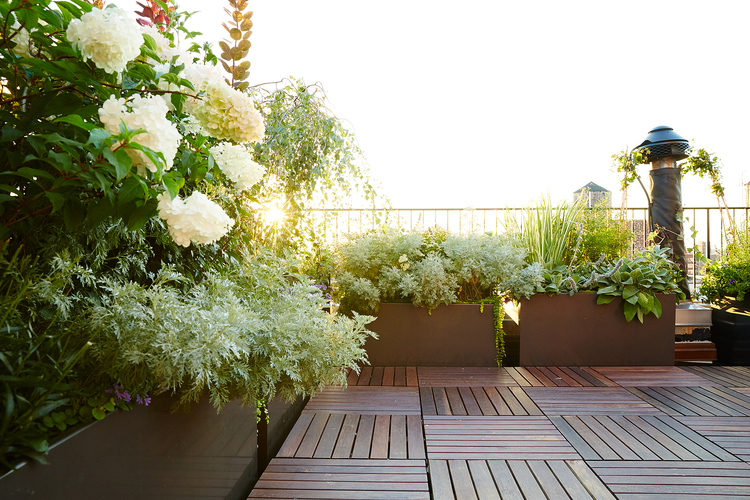
A small garden is not a miniature large garden — it's a space in its own right, with its constraints and assets. And often, space constraints push creativity: the most beautiful urban gardens are frequently the smallest. The key? Think in three dimensions, play with volumes, and choose each plant with intention.
3 key principles:
- ↑ Verticality multiplies your planting surface by 3 or 4
- ×5 more yield with well-designed raised beds
- 3D: Think in layers — ground, shrubs, climbers, pergolas
Design before planting: the scale plan
Before buying a single plant, take time to draw your space to scale. This simple exercise reveals unused areas, circulation conflicts and hidden opportunities. Measure everything: the terrace, passages, shaded areas, wall widths.
In a small garden, every decision matters. Furniture that's too large overwhelms the space, a poorly traced path eats into plantable surface. Ask yourself three essential questions: how do I move around? where do I sit? and where do I plant? All design flows from these three answers.
"A well-thought-out small garden always gives the impression of being larger than it is. It's a question of perspectives, not square metres."
Exploiting verticality
This is principle number one of the small garden: what you can't extend in width, raise in height. Walls, fences, pergolas and trellises are planting surfaces in their own right — often completely underexploited.
The 4 levels of vertical planting:
- Level 4 (High): Climbing roses, hops, ornamental vine, jasmine, clematis
- Level 3 (Middle): Climbing beans, cucumbers, squash, wisteria, nasturtiums
- Level 2 (Low): Strawberries, creeping thymes, sedum, aromatic herbs in pots
- Level 1 (Ground): Bulbs, ground covers, low perennials, lettuce, radishes
A 5-metre long fence at 1.8 m high represents 9 m² of vertical planting surface — often more than some entire small gardens. Dressing your walls is the highest aesthetic and ecological return investment in a constrained space.
💡 Trellis detached from wall: Place your trellis 5–8 cm from the wall rather than in contact. Air circulates, plants are less prone to disease, and the wall is protected from moisture.
Choosing multifunctional plants
In a reduced space, every plant must earn its place. Exit plants that only flower for a week and have no other interest. Favour plants that combine several assets: long flowering, interesting foliage, berries for birds, fragrance, edible.
- Long flowering: Agastache, salvia, echinacea, scabious — flower from June to October without interruption.
- Beautiful AND edible: Blueberries, strawberries, nasturtiums, borage — ornamental and productive at once.
- Four seasons: Red dogwood, viburnum, ivy — interest in flower, fruit, foliage and silhouette.
- Mobile pots: Containers allow reorganising according to season and bringing out plants at their flowering time.
Playing with pots and containers
Container gardening is often perceived as a constraint. In reality, it's a tremendous freedom: you adapt the substrate to each plant, you move according to seasons, and you invest mineral spaces (terrace, balcony, path) without works.
- ✓ Vary heights: group pots of different sizes to create volume and visual depth.
- ✓ Opt for large containers: a large pot keeps moisture longer and allows more developed rooting than a row of small pots.
- ✓ Choose natural materials: terracotta, wood, reconstituted stone — they breathe better than plastic and integrate well visually.
- ✓ Create mixed compositions: combine a tall plant, a trailing one and a ground cover in the same large container.
Creating the illusion of space
A few well-chosen visual tricks can give the impression your garden is twice as large as it actually is.
- ✓ Place tall plants at the back of the garden and shorter ones in the foreground: perspective accentuates depth.
- ✓ A well-placed garden mirror on a wall visually doubles the space and reflects light into dark areas.
- ✓ Curved paths hide the garden's end and suggest a space that continues beyond.
- ✓ Limit the colour palette: a garden with few well-chosen colours seems more coherent and larger than a multicoloured patchwork.
🎨 Cool colours rule: Cool colours (blue, mauve, white) at the back of the garden and warm colours (yellow, orange, red) in the foreground amplify the sense of depth.
Small space, big garden
An optimised small garden is often richer, denser and more alive than an ordinary large garden. Space constraints force you to choose, prioritise, invent — and that's precisely what makes them such endearing and personal places.
Start with the plan, think vertical, select multifunctional plants — and let every square metre tell a story. The most beautiful gardens are not the largest, but the most thought-out. 🌿