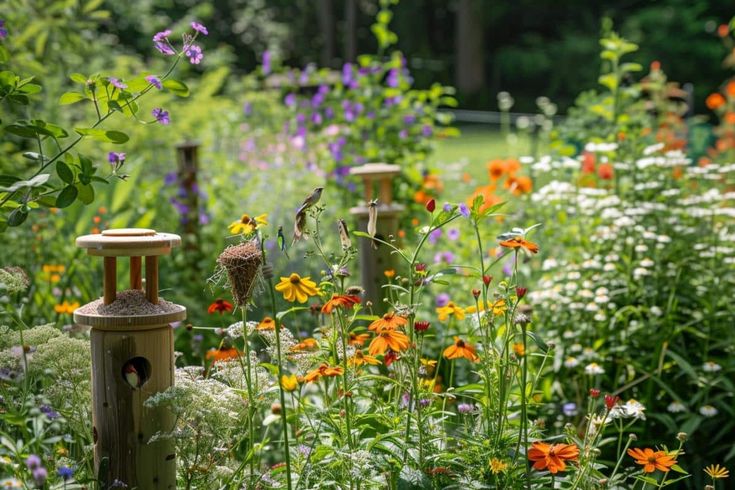
Hearing a robin sing in the early morning, watching a peacock butterfly flutter between flowers — these little moments of grace are not a matter of chance. They are cultivated, gently, with a few simple gestures and a lot of attention to the living world around us.
What they need
For birds: They need three things: something to eat, water to drink and bathe in, and shelter to nest or rest.
For butterflies: They look for host plants to lay eggs, nectar-rich flowers to feed on, and sunny areas to warm up.
Feeding and watering birds
Food is the first lever to attract birds. In winter, a well-stocked feeder can literally save lives — small passerines burn considerable energy to maintain their body temperature. But the food supply doesn't stop at the feeder: your entire garden can become a natural pantry.
- Sunflower seeds and cereal mixes for tits, finches and sparrows.
- Persistent berries (holly, viburnum, dogwood, elderberry) for blackbirds and thrushes in autumn-winter.
- Flower heads left in place — teasels, echinacea, sunflowers — for goldfinches and linnets.
- A shallow basin or tray, cleaned regularly, for drinking and bathing. Essential in freezing weather.
🏡 Nest boxes: Install your nest boxes in January-February, facing east or north-east, at 2–4 m height. Clean them each autumn after the nesting season.
Creating a paradise for butterflies
Attracting butterflies requires thinking about two stages of their life: the adult butterfly, which feeds on nectar, and the caterpillar, which feeds on leaves. A flower lawn without host plants will only attract passing visitors — for butterflies to settle and reproduce, you must also feed their larvae.
- Common nettle: host plant for the Peacock, Small Tortoiseshell, Comma and Red Admiral. Leave a sunny corner of nettles — it's a goldmine.
- Cuckooflower: essential for the Orange-tip, this white-orange butterfly of wet meadows.
- Fennel, wild carrot, dill: host plants for the Swallowtail, the largest butterfly in our regions.
- Clover and alfalfa: feed the caterpillars of the Clouded Yellow and Common Blue.
"A garden without nettles is a garden without Peacock butterflies. Sometimes, apparent disorder is the greatest wealth."
For adults seeking nectar, focus on flowers rich in accessible pollen and nectar: lavender, buddleia, agastache, scabious, verbena bonariensis, oregano. Avoid double flowers which, pretty to the eye, are often inaccessible to insects.
Plants that attract both at once
Some plants have the rare talent of simultaneously attracting birds and butterflies, at different stages of their cycle:
- Black elderberry: flowers for pollinators in spring, berries for birds in summer-autumn
- Climbing ivy: late flowers in autumn for the last butterflies, winter berries for birds
- Scabious: abundant nectar for butterflies, seeds for birds
- Echinacea: visited by butterflies in summer, seeds appreciated by goldfinches in autumn-winter
- Dogwood: early flowers, nutritious berries
🌳 The mixed hedge, complete habitat: A hedge of varied native shrubs (blackthorn, viburnum, hawthorn, elderberry, dogwood) is the best investment for both groups: shelter, food, nesting site, everything is there.
What to absolutely avoid
Some common practices in conventional gardens are real deterrents for birds and butterflies. Eliminating them often costs zero effort and makes a huge difference.
- Insecticides, even "organic" ones: they kill caterpillars indiscriminately. A garden without caterpillars is a garden without butterflies — and without food for tits.
- Short-mown lawn: it offers neither shelter nor food. Let tufts of grass grow and some "weeds" like clover and dandelion.
- Bird nets on berry bushes outside harvest season. Berries are a vital resource in winter.
- Gardens too "clean" in autumn: dead leaves, hollow stems and stumps are precious overwintering habitats for chrysalises and insects.
A garden that sings and dances
Attracting birds and butterflies is not a checklist — it's a gardening philosophy that consists of leaving space, diversity and a bit of benevolent disorder. Every uncut flower, every corner left wild, every hedge planted is a signal sent to wildlife: here, you are welcome.
And the reward comes quickly — often from the first season. A few butterflies first, then the tits discovering the feeder, then a blackbird settling in the hedge. Nature always responds to those who extend a hand. 🌸